
Reading time: 6 minutes
There's a Japanese legend that foragers who found this mushroom in the wild would dance with joy — because it was so rare and so valuable it could be traded for its weight in silver. That's where the name comes from: maitake, the "dancing mushroom." Today it's cultivated and far more accessible, but the scientific interest that made it famous is still very much alive.
What is Maitake?
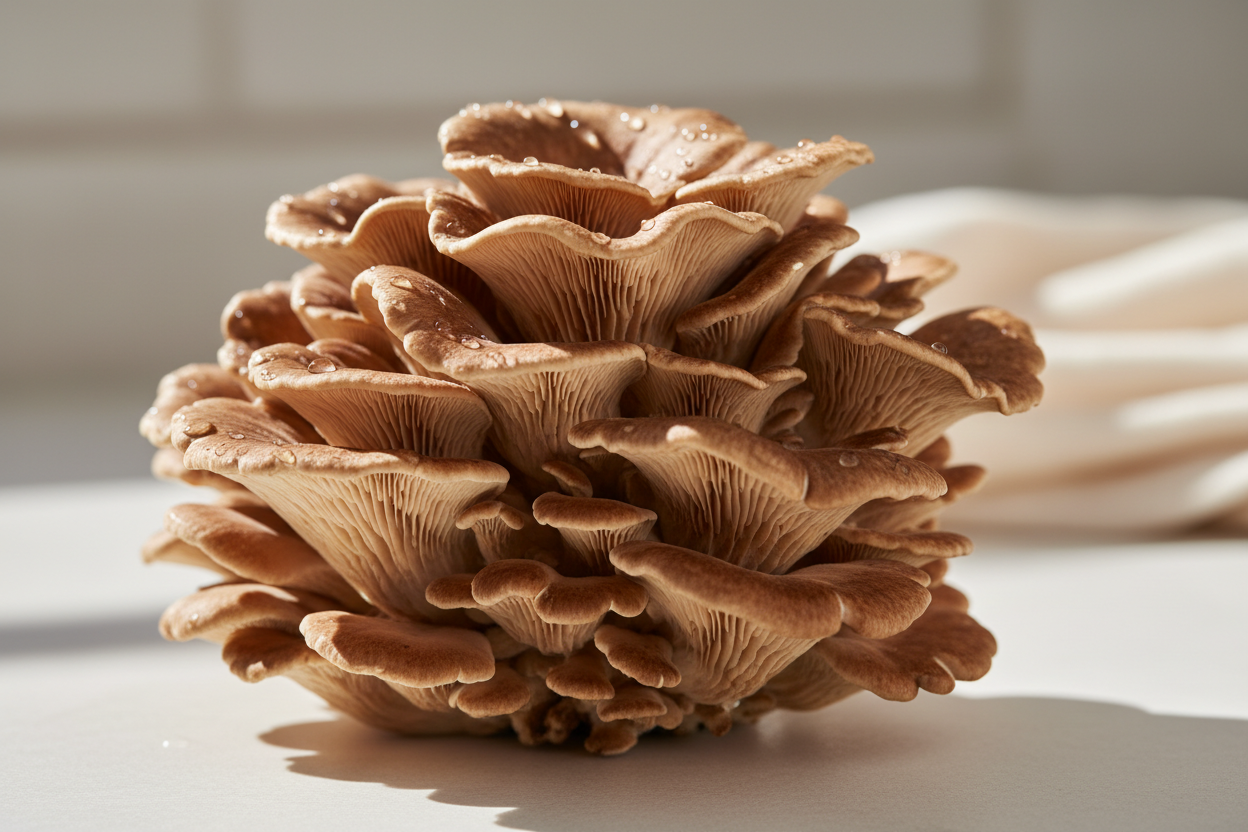
Maitake (Grifola frondosa) is a large, fan-shaped mushroom that grows in overlapping clusters at the base of oak, elm, and maple trees. In North America it's known as "hen of the woods," and individual specimens can grow enormous — some reaching over 45 kilograms in a single season.
Here's a detail that explains a lot about its history: maitake couldn't be cultivated artificially until the mid-1980s. Before that, it was wild-harvest only — genuinely rare, which is why it was so prized in traditional Japanese and Chinese practice, primarily for immune support and general vitality. Once Japanese cultivators figured out how to grow it, production exploded — Japan was producing nearly 40,000 metric tons a year by the late 1990s.
That cultivation breakthrough is also what kicked off the modern research era.
The compound Maitake is famous for: the D-fraction
Most mushrooms in this blend are studied for their beta-glucans in general. Maitake is different — researchers isolated a specific beta-glucan fraction from its fruiting body and gave it a name: the D-fraction (and a more purified version, the MD-fraction).
Structurally, it's a beta-glucan with a β-1,6 main chain and β-1,3 branches — a configuration that researchers found particularly interesting for its interaction with immune cells. In laboratory and animal studies, the D-fraction has been shown to activate components of the immune system including macrophages, natural killer cells, and T-cells.
This is worth pausing on, because it's the reason Maitake earns its place in a serious blend: it's not just "a mushroom with beta-glucans." It's a mushroom with a named, characterised, specifically-studied beta-glucan fraction — one that's been the subject of decades of research, much of it conducted in Japan.
What the research shows — and what it doesn't
The Maitake D-fraction has an unusually deep preclinical research record. Studies have documented its effects on various immune parameters — the activation of immune cells, the balance between different T-cell populations, and immunomodulation more broadly. Some of this work has extended into early clinical settings.
But — the same honest caveat applies here as with every mushroom in this series. A large share of the strongest findings come from cell cultures, animal models, and small early-stage human studies, much of it from a single research group in Japan. The results are genuinely promising and genuinely interesting. They are not the same thing as large-scale, replicated clinical proof.
What makes Maitake stand out isn't certainty — it's specificity. The D-fraction gives researchers something concrete to study, which is more than can be said for many vaguely-marketed mushroom ingredients.
Why the fruiting body matters (again)
Notice something in the research above: the D-fraction is extracted from the fruiting body. That's not a coincidence in how we're framing this — it's where the characterised, studied fraction actually comes from.
As with the rest of our mushrooms, a lot of cheaper Maitake supplements are made from mycelium grown on grain, ground up and encapsulated. On a lab report, these show high alpha-glucans (the leftover starch) and low beta-glucans. If the beta-glucans are what the research is about, a starch-heavy product isn't delivering what the label implies.
This is why THRILL+ uses fruiting body only for Maitake, at a 10:1 extract ratio, with a verifiable beta-glucan specification. When a mushroom's reputation is built specifically on a fruiting-body fraction, using anything else would be missing the point.
The bottom line
Maitake went from silver-grade rarity to one of the most-researched immune mushrooms in the world in the span of a few decades — and its D-fraction gives it one of the most specific research stories in the entire functional category. We include it in THRILL+ as fruiting body, because that's where the science actually lives, and because a verifiable beta-glucan number is the only honest way to prove it.

Einen Kommentar hinterlassen
Diese Website ist durch hCaptcha geschützt und es gelten die allgemeinen Geschäftsbedingungen und Datenschutzbestimmungen von hCaptcha.