
Reading time: 6 minutes
Few mushrooms carry as much mythology as Reishi. In traditional Chinese medicine it was called lingzhi a name tied to spiritual potency and longevity — and it was reserved for emperors. Two thousand years later, it's one of the most-studied mushrooms in the functional category. Here's what the research supports, what it doesn't, and why quality varies more wildly with Reishi than almost any other mushroom.
What is Reishi?
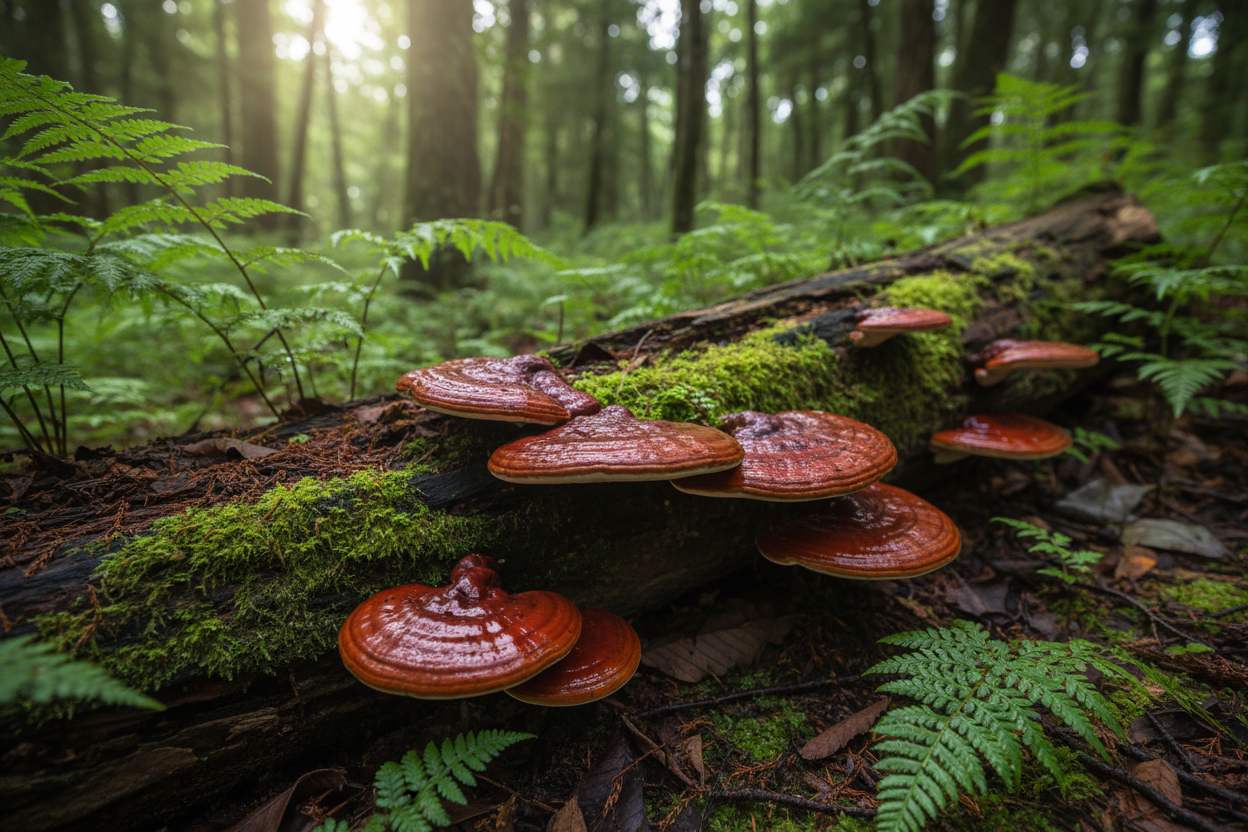
Reishi (Ganoderma lucidum) is a tough, woody, bitter mushroom that grows on hardwood trees. Unlike Shiitake or Lion's Mane, you don't eat Reishi it's far too hard and bitter. For centuries it has instead been prepared as a tea or decoction, simmered in water for one to two hours to draw out its water-soluble compounds. That traditional preparation is a clue to its chemistry, and we'll come back to it.
In traditional East Asian practice, Reishi was valued as a tonic associated with vitality, calm, and the heart. Today, it's one of the few mushrooms to have been the subject of genuine placebo-controlled human research.
The two compound families that define Reishi
Reishi is unusual because it contains roughly 400 bioactive compounds, but two families do most of the heavy lifting in the research:
Beta-glucans the polysaccharides found across medicinal mushrooms. In Reishi, these are the water-soluble compounds that traditional tea preparation was (unknowingly) extracting. They're the focus of most of Reishi's immune-related research.
Triterpenes specifically ganoderic acids. These are what give Reishi its intense bitterness, and they're relatively unique to this mushroom. They're so characteristic that in Japan, ganoderic acid content is used as a quality marker for Reishi products. If a Reishi extract isn't bitter, it's fair to ask how much triterpene content it really has.
What the research shows — and what it doesn't
This is where Reishi stands out from most functional mushrooms: there's actual human clinical work, not just cell and animal studies.
One randomised, double-blind, placebo-controlled trial in healthy adults looked at Reishi-derived beta-glucan taken daily over 84 days, and reported measurable changes in several immune cell populations compared to placebo —including natural killer cell activity and T-lymphocyte counts. The intervention was well tolerated.
That's a meaningfully stronger evidence base than many mushrooms can claim. But context matters: much of the broader Reishi literature still consists of preclinical studies, and reviewers consistently note that rigorous, large-scale clinical evidence remains limited. Many of Reishi's traditional reputations rest on centuries of use and cultural knowledge rather than modern trials.
So the honest summary: Reishi is one of the better-researched functional mushrooms, its beta-glucans are a legitimate subject of immune research, and its triterpenes are genuinely distinctive but it's still an area of ongoing science, not settled fact.
Why quality varies so much with Reishi
Here's the practical part, and it's bigger for Reishi than for almost any other mushroom.
Because Reishi's key compounds are split between water-soluble beta-glucans and the bitter triterpenes, how it's extracted determines what you actually get. And because the fruiting body is where the characteristic triterpene profile is richest, the fruiting-body-versus-mycelium question really matters here.
A lot of cheaper Reishi supplements are made from mycelium grown on grain, ground up and encapsulated. On a lab report, these products tend to show high alpha-glucans (starch from the growing substrate) and low beta-glucans the opposite of what you want. You can be paying for oats with a Reishi label.
This is why THRILL+ uses fruiting body only for Reishi, at a 10:1 extract ratio, with a verifiable beta-glucan specification. If you're going to include a mushroom this storied, the fruiting body is the part that earns the reputation and the part a lab test can actually stand behind.
The bottom line
Reishi has a two-thousand-year head start on almost everything in your supplement cabinet, and unusually for a functional mushroom, modern research has started to catch up. We include it in THRILL+ because it's one of the few mushrooms with real human data behind its beta-glucans and we use the fruiting body because that's where the quality, and the honesty, actually lives.

Leave a comment
This site is protected by hCaptcha and the hCaptcha Privacy Policy and Terms of Service apply.