
Reading time: 6 minutes
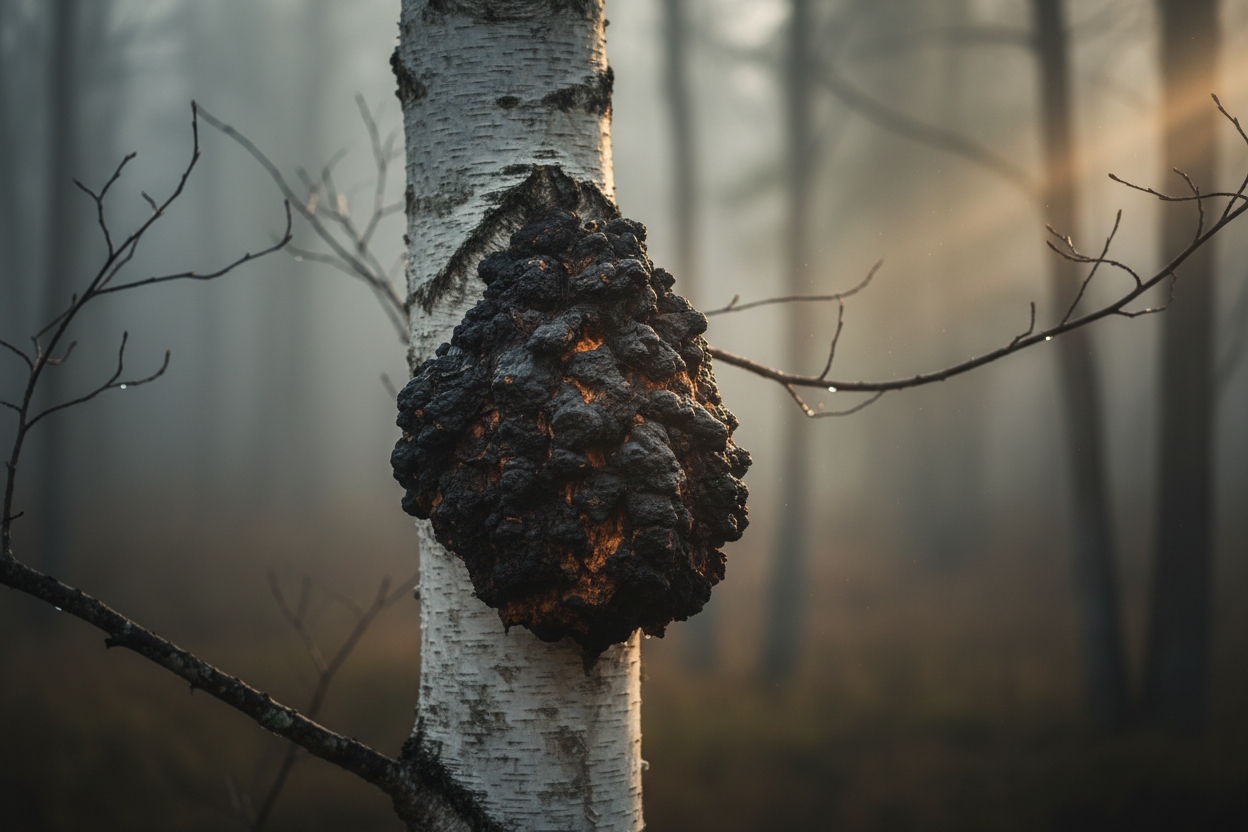
Chaga breaks almost every rule in this series. It doesn't look like a mushroom — it looks like a lump of burnt charcoal growing out of a birch tree. It isn't a fruiting body in the way the others are. And its most interesting compounds don't even come from the fungus alone. Here's the honest, fascinating story of the strangest ingredient in the blend.
What is Chaga?
Chaga (Inonotus obliquus) is a parasitic fungus that grows on birch trees in the coldest parts of the world — Siberia, Scandinavia, Canada, Alaska, and northern Russia. It has a black, cracked, charcoal-like exterior and a soft amber-orange interior.
For centuries it's been used in the folk medicine of Siberia, Northern Europe, and Indigenous North American cultures — typically brewed into a tea or decoction. Its traditional reputation is broad: it appears in the ethnomedicine of the Khanty people of Siberia, and was even noted in Soviet-era medical observation (Alexander Solzhenitsyn referenced it in Cancer Ward, drawn from his own experience).
The honest part: Chaga isn't a fruiting body
We use "fruiting body only" as a core principle for THRILL+, so we owe you a straight explanation here.
Chaga doesn't form a normal fruiting body the way Shiitake or Reishi do. What you harvest — the black birch conk — is a sclerotium: a dense mass of fungal tissue mixed with material from the birch tree itself. This isn't a loophole or a downgrade; it's simply Chaga's biology. There is no "fruiting body" version of Chaga to choose instead. The conk is the part that has been used for centuries and the part the research is done on.
We'd rather explain that plainly than let "fruiting body only" quietly imply something that isn't biologically possible for this particular species. That's the whole point of how we label.
The compounds — and a genuinely interesting twist
Chaga's chemistry is unusual and worth understanding.
Melanin — Chaga's black exterior is one of the most melanin-dense natural materials known. Researchers have studied this water-soluble melanin fraction for its antioxidant and immunomodulatory activity.
Triterpenoids — especially betulin and betulinic acid — and here's the twist. These compounds are derived from betulin, which Chaga absorbs from the birch bark it grows on. In other words, part of what makes birch-grown Chaga interesting comes from the tree, not just the fungus. This is why the substrate genuinely matters for Chaga in a way it doesn't for other mushrooms: wild birch-grown Chaga has a compound profile that lab-cultured versions struggle to replicate.
Polyphenols and polysaccharides — the water-soluble compounds that traditional tea preparation extracted, studied for antioxidant activity.
What the research shows — and what it doesn't
Chaga has an active research literature focused on its antioxidant capacity, its triterpenoids (betulinic acid in particular has attracted interest), and its melanin and polysaccharide fractions. Much of this work explores immunomodulatory and antioxidant mechanisms.
The honest caveat is the strongest for Chaga of any mushroom here: the overwhelming majority of Chaga research is in-vitro (test tube) and animal work. Human clinical trials are scarce. The traditional use is centuries deep and the biochemistry is real and interesting — but the modern clinical evidence base in humans is genuinely thin, and no serious source claims otherwise.
We include Chaga for its traditional standing and its distinctive antioxidant-compound profile — not because it's clinically proven to do anything specific in people.
What quality means for Chaga
Because Chaga's key triterpenoids come partly from the birch host, wild birch-grown Chaga is the meaningful quality marker — not the fruiting-body-vs-mycelium question that applies to the other five. A Chaga grown away from birch, or cultured in a lab, can lack the betulin-derived compounds that make it interesting in the first place.
For Chaga, THRILL+ specifies the material on a total-polysaccharide basis and sources it as the traditional birch conk — because with this particular fungus, that's what the centuries of use and the research actually refer to.
The bottom line
Chaga is the outlier of the blend: not a true fruiting body, not backed by much human clinical data, but carrying centuries of traditional use and one of the most distinctive natural compound profiles you'll find — part fungus, part birch tree. We include it, we're honest about what it is, and we don't dress a sclerotium up as something it isn't. That honesty is exactly the point.

Laisser un commentaire
Ce site est protégé par hCaptcha, et la Politique de confidentialité et les Conditions de service de hCaptcha s’appliquent.