
Reading time: 7 minutes
Cordyceps has one of the strangest origin stories in the natural world, one of the most interesting research profiles in the endurance space and one of the most misleading labelling practices in the entire supplement industry.
We're going to walk through all three, including the part most brands would rather you didn't know. Because if there's one mushroom where transparency separates the honest companies from the rest, it's this one.
What is Cordyceps?
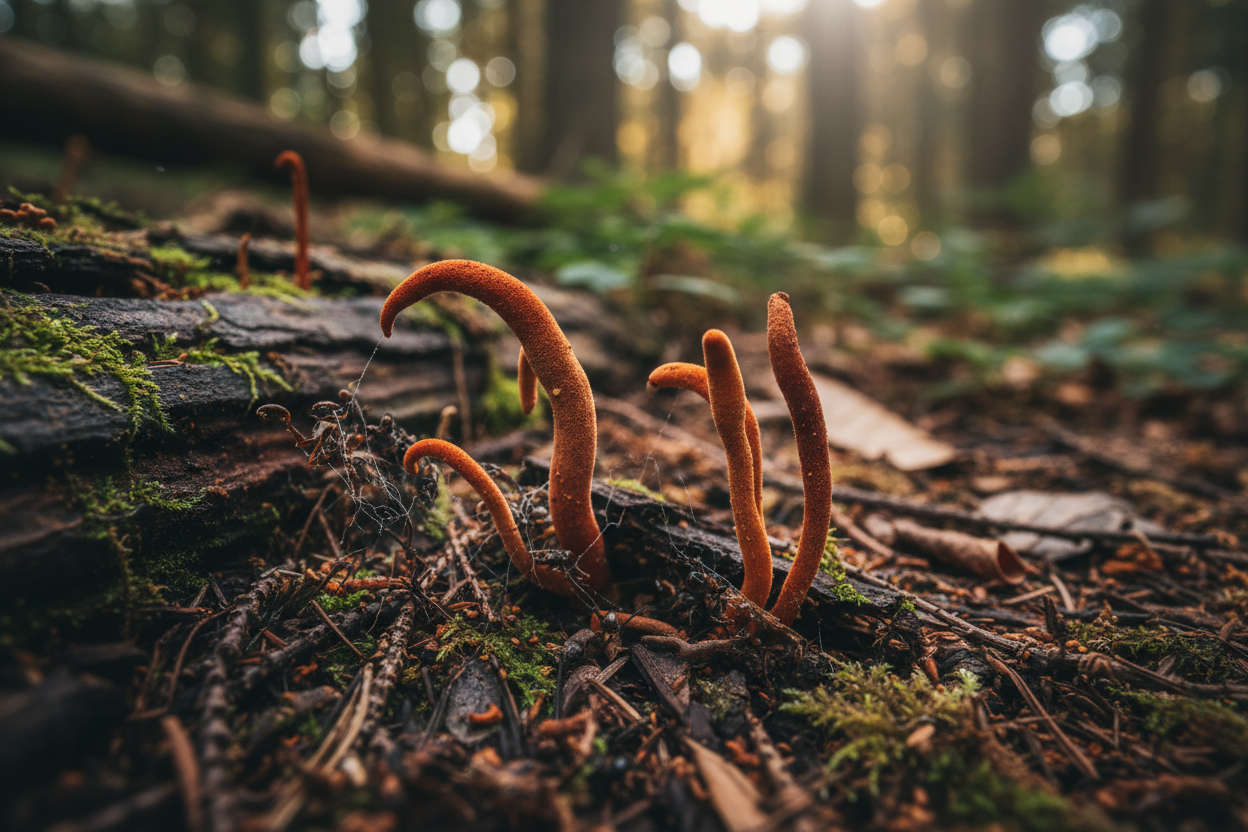
Wild Cordyceps sinensis (recently reclassified as Ophiocordyceps sinensis) grows in one of the most extreme places on Earth: the Tibetan Plateau, at elevations above 3,000 metres. It's a parasitic fungus that infects moth larvae, eventually replacing the caterpillar's body with mushroom. The Tibetan name, yartsa gunbu, translates roughly as "winter worm, summer grass."
For centuries, herders and traditional healers in Tibet and Nepal used it for energy, stamina, and resistance to the exhaustion of high-altitude life. It was reserved for emperors and nobility and for good reason. It's one of the rarest natural substances in the world.
The price problem nobody talks about
Here's the fact that quietly shapes every Cordyceps supplement on the market: wild Cordyceps sinensis costs between $20,000 and $110,000 per kilogram.
That's not a typo. It's hand-harvested from remote high-altitude terrain, and it's so valuable it's called "soft gold" in China.
Which raises an obvious question: if wild Cordyceps sinensis is that expensive, what exactly is in the $30 bottle of "Cordyceps sinensis" gummies or capsules you see everywhere?
The answer is almost never wild fruiting body. It can't be the maths doesn't work.
What's actually in Cordyceps supplements
There are two realistic, legitimate sources used across the entire industry:
Cs-4 a specific strain first isolated in China in the 1980s, produced through liquid fermentation. It's technically mycelium, and it's the form used in most of the classic human research. Importantly, because it's grown by liquid fermentation rather than on grain, it doesn't carry the grain-filler problem that plagues other mushroom mycelium products.
Cordyceps militaris a related species that can be cultivated as a fruiting body, and contains higher levels of a compound called cordycepin. However, in the EU, militaris is classified as a Novel Food which restricts its use in supplements.
And here's the honest bottom line that most brands hide: real Cordyceps sinensis fruiting body essentially does not exist at commercial scale. It's wild-harvest only, at astronomical prices. So when you see "Cordyceps sinensis" on a label, it is almost certainly Cs-4 mycelium whether the brand tells you or not.
Most don't tell you. We do.
The research: what Cordyceps has actually been studied for
Cordyceps is best known in the research world for endurance and aerobic capacity, and this is where Cs-4 specifically has a track record.
A frequently-cited randomised, double-blind, placebo-controlled trial gave healthy older adults 3 grams of Cs-4 daily for six weeks. The Cs-4 group showed increases in VO2max (a measure of aerobic capacity) and anaerobic threshold, while the placebo group didn't change. Separate work in long-distance runners has also explored effects on time-to-exhaustion and VO2max.
The proposed mechanisms are interesting: Cordyceps contains adenosine and cordycepin (a close structural cousin of adenosine), compounds involved in cellular energy transfer and oxygen utilisation. Adenosine content is actually used as a standardisation marker for Cs-4 quality.
But and this matters the evidence is mixed and dose-dependent. Some trials in trained athletes found no significant effect. And the doses used in most studies (3–4 grams per day) are far higher than what any gummy or capsule blend can realistically deliver. Cordyceps is a genuinely interesting endurance-research subject, not a proven pre-workout.
Where THRILL+ stands
We use Cs-4 for the Cordyceps in THRILL+, and we say so plainly on the label and here.
Why? Because your other options are wild sinensis (commercially impossible), or militaris (Novel Food restricted in the EU). Cs-4 is the legitimate, well-researched, grain-free choice the same form behind most of the classic Cordyceps human studies.
For our other five mushrooms, we use fruiting body only. Cordyceps is our one honest exception and we'd rather tell you exactly what it is than print "Cordyceps sinensis" and let you assume you're getting $40,000-per-kilo Tibetan mushroom in a berry gummy.
That's the whole philosophy: you can't make a good decision about a product that lies to you about what's in it.
The bottom line
Cordyceps is a fascinating mushroom with real endurance research behind it, a genuinely bizarre natural history, and an industry-wide labelling problem. We can't change the first two. But we can be honest about the third which is why we tell you our Cordyceps is Cs-4, why that's actually the right choice, and why the brands that don't mention it are hoping you won't ask.

Laat een reactie achter
Deze site wordt beschermd door hCaptcha en het privacybeleid en de servicevoorwaarden van hCaptcha zijn van toepassing.